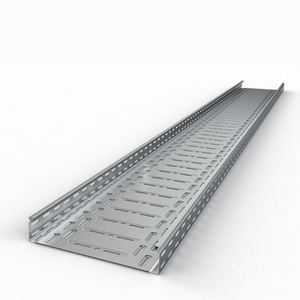
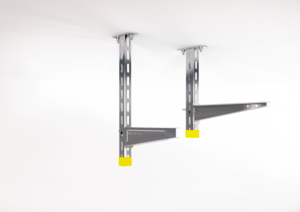
| Under the Building Regulations, every building must be equipped with escape and rescue routes to ensure that people can be rescued in the event of a fire. Depending on the type of building, at least one escape and rescue route is required. Other escape and rescue routes include necessary stairwells and corridors, the connecting spaces between stairwells and corridors, and exits to the outside. It must be possible to use these routes safely even in the event of a fire. Electrical cables must therefore be installed: • in installation shafts and ducts • above suspended ceilings • in underfloor ducts or raised floors Section 3.5.3 of the Model Cable Installation Guideline (Muster-Leitungsanlagen-Richtlinie, MLAR) states that, in required corridors, cable installations may be laid above suspended ceilings (i.e. in the space between the structural ceiling and the suspended ceiling) provided that the suspended ceiling can be classified as fire resistance class F30 when exposed to fire from both above and below. Fire-resistant fixings are required for securing the cable systems. Our range includes tested systems for cable installation in the space between suspended ceilings. Our product solutions comply with the guidelines set out in the MLAR for the protection of the F30 suspended ceiling. When our cable support systems are used, escape and rescue routes remain safely usable for at least 30 minutes in the event of a fire. The expert opinion MLAR 2101/407/18-CM is available in our Download Centre (only in german). |